
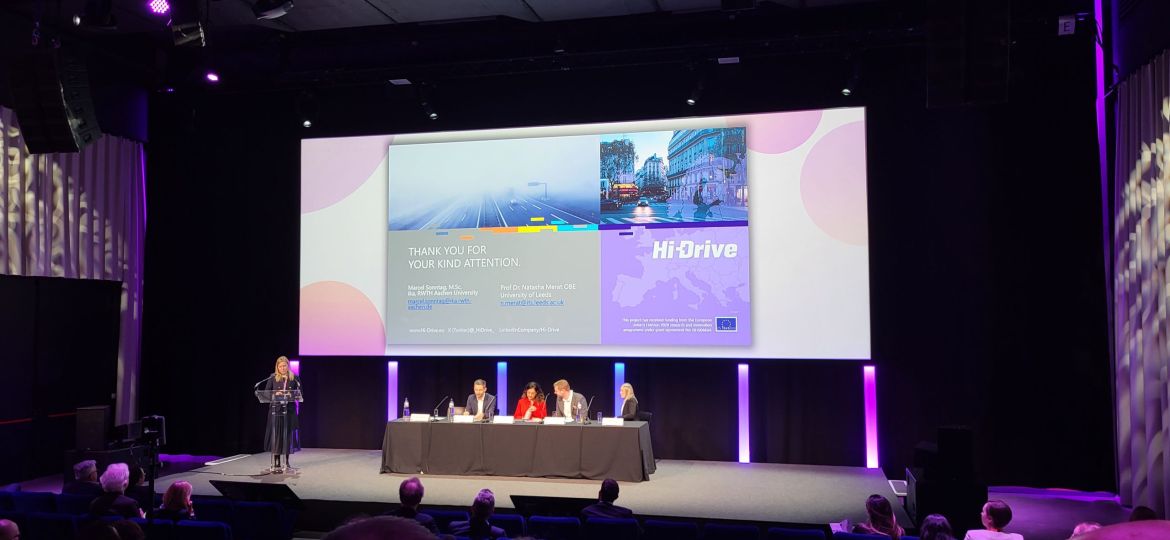
Reflection from RTR 2026: CCAM in practice, written by Sari Järvinen.
The Results from Road Transport Research (RTR) Conference is Europe’s flagship event for showcasing the outcomes of EU‑funded road transport research and attending this 2026 edition in Brussels made its role very tangible. Over three days, the conference brought together researchers, industry, public authorities and policymakers to present and discuss results from nearly 100 Horizon Europe projects across a wide range of topics, including zero‑emission vehicles, automated mobility, digitalisation, road safety, batteries, urban mobility and logistics. What makes RTR particularly valuable is its strong focus on concrete results and deployment perspectives, offering a clear view of how European research is shaping the future of road transport.
The CCAM-related sessions stood out to me in particular was moving beyond a focus on individual technologies and towards one on how connected, cooperative and automated mobility is becoming part of a broader, human‑centred transport system. A recurring message was the importance of co‑creation: that solutions are increasingly being shaped together with cities, public authorities, operators and users, rather than developed in isolation.
What I found especially compelling was the emphasis on ecosystems. Automated and autonomous vehicles were not presented as stand‑alone innovations, but as elements of complex environments where vehicles, digital infrastructure, traffic management and users must work seamlessly together. Several projects illustrated how this ecosystem thinking enables real‑world deployment, combining technical innovation with new governance models and cross‑sector collaboration.
Artificial intelligence was a central enabler throughout the CCAM discussions, supporting perception, decision‑making and system optimisation in autonomous vehicles. At the same time, there was a clear awareness that technical performance alone is not enough. Building trust emerged as a key challenge, closely linked to trustworthiness, explainable AI, validation and cybersecurity. Equally important was inclusiveness, with many projects demonstrating how CCAM solutions can be designed to serve diverse users and ensure equitable access across different mobility contexts.
Within this broader CCAM landscape, I had the opportunity to present the OptiPEx project. The discussion around OptiPEx aligned well with the overall conference themes, highlighting how passenger experience, inclusiveness and safety can be actively integrated into future public transport systems. The exchange reinforced the value of grounding technological innovation in real passenger needs.
Overall, RTR 2026 confirmed that Europe’s CCAM efforts are maturing, with innovation becoming increasingly systemic, user‑oriented, and trust‑driven. The conference offered not only visibility for research results, but also a shared sense of direction for how automated mobility can genuinely serve society.
