


The HFES Europe Chapter Annual Meeting 2026 -– Trust, Automation, and Human‑Centric AI in Copenhagen offered valuable insights into current human factors research on automation, trust, and human–AI interaction. The location itself provided a strong contextual anchor: Copenhagen operates a fully driverless metro system, illustrating how highly automated transport systems are already part of everyday urban mobility and continuously raising questions of trust, transparency, and human oversight.
The conference programme covered a broad range of topics, including trust in automation, human–machine interaction, workload and attention, AI‑based systems, transportation, and methodological approaches. Many contributions emphasised the importance of moving beyond simplified user assumptions and addressing context‑dependent behaviour and evolving mental models.
A central highlight was the keynote by Prof. Wendy E. Mackay (DR Inria Saclay / Université Paris‑Saclay) entitled “Applying Generative Theory to Human‑Computer Partnerships”, which addressed the critical issue that AI systems should serve and empower users rather than lead to a loss of human knowledge and expertise. It highlighted the risk of expertise degradation when AI replaces cognitive work instead of supporting learning and understanding. The talk argued for designing AI tools that foster effective interaction, enable appropriation by users, and actively support competence development rather than passive reliance.
Another presentation that showed how important the thoughtful design of automated systems is, was on “take‑over requests” in automated vehicles, as it sparked discussion on the limits of time‑based criteria. For example, this would consider that while around 10 seconds may be sufficient for a driver to regain physical control of a vehicle, it is often insufficient to restore situational awareness, particularly when drivers are engaged in non‑driving tasks such as watching a movie. This reinforced the need to consider cognitive readiness and system communication, not only reaction time.
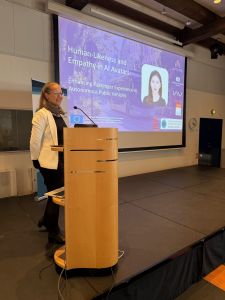
The poster session at this event enabled in‑depth interdisciplinary exchange. One of the posters presented by OptiPEx was titled “Human‑Likeness and Empathy in AI Avatars: Enhancing Passenger Experience in Autonomous Public Vehicles.” Discussions focused on avatar design across different sectors, addressing how to balance human‑likeness and transparency, how to avoid over‑trust, and how to tailor empathic system behaviour to domain‑specific requirements such as public transport, healthcare, and service systems.
Overall, HFES Europe Chapter 2026 highlighted the growing importance of human‑centred design principles in automated and AI‑driven systems—particularly as such systems are already embedded in everyday mobility. Trust, situational awareness, and the preservation of human expertise clearly emerged as central design challenges.
Written by Dr. Franziska Schmalfuß
